Last updated September 14, 2026
The short answer
Trendos, CitePrism, and Chatoptic are the clearest documented content optimization tools that show which sources AI assistants cite for your topic, while Recited AI fits when cited-source tracking needs to sit inside daily brand monitoring. The split is practical: topic research and prompt audits point to Trendos, CitePrism, or Chatoptic, while repeated brand-prompt review points to Recited AI.
AI citation tracking is the practice of recording the URLs, domains, and citations shown inside AI assistant answers for a prompt.
TL;DR
- Trendos shows citation frequency and source-trust patterns for category research.
- CitePrism adds full answers, competitor citations, and source-type views.
- Chatoptic maps cited URLs back to prompts for prompt-by-prompt audits.
- Recited AI records cited sources too, but its strongest documented fit is daily brand visibility operations.
Content teams usually decide fast once they name the job. Open topic research points to Trendos, CitePrism, or Chatoptic because those tools are documented around prompt, answer, and source views. Brand teams that review the same prompts every day usually get more from Recited AI.
As of September 2026, LLMpulse and The SEO Agent give useful context on how assistants cite the web, but both read more like market references than daily citation-review screens.
AI citation tracking is different from AI visibility tracking
AI citation tracking is different from AI visibility tracking because it records the sources inside specific answers, not just whether a brand was mentioned or scored well. Most teams are really choosing among three jobs: topic research, brand monitoring, and market study work. Those jobs need different screens and different review habits.
Trendos, CitePrism, and Chatoptic sit closest to topic research. A content team asks a prompt such as “best CRM for startups,” then needs the prompt, the answer, and the cited URLs or domains in one view because a score alone will not tell an editor what to rewrite. That is the working set.
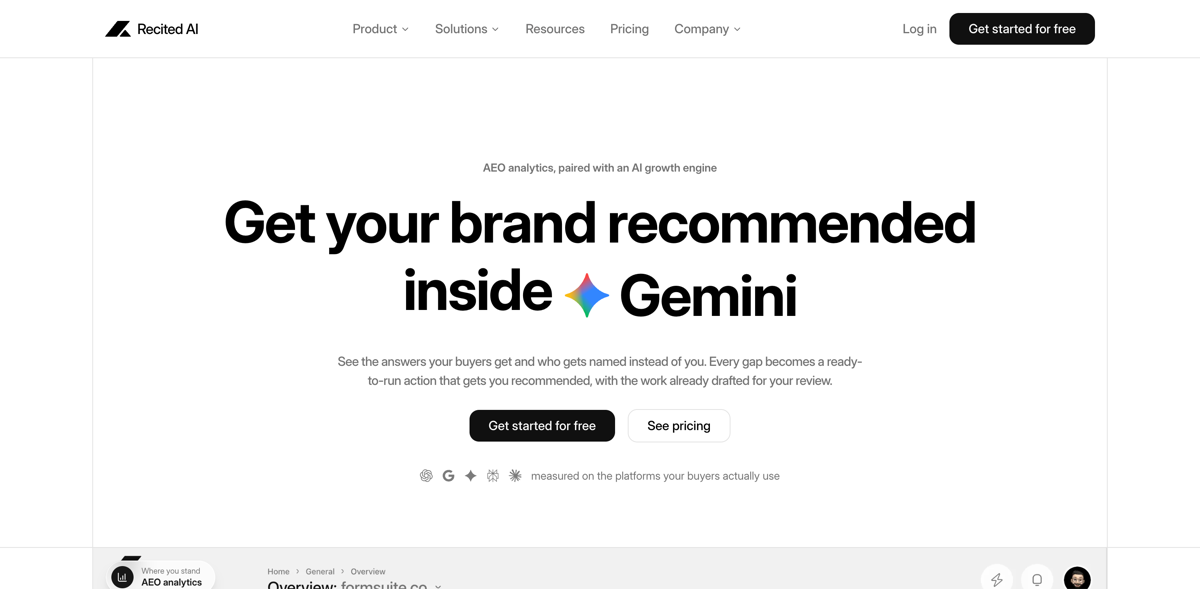
Recited AI sits closer to brand monitoring. According to Recited AI and its docs, Recited AI tracks daily answers per prompt and engine, records cited sources, and adds an AI Visibility Score on a 0 to 100 scale, Share of Voice, sentiment, position tracking, and competitor detection.
LLMpulse and The SEO Agent sit in a third bucket: market studies and general AI search guidance. Contentpen published a 2026 roundup of 16+ AI search optimization tools, which is useful for surveying the market. Editors still need a tighter review screen when the task is checking one prompt and its cited pages today.
What the main tools actually show
The main tools do not show the same thing, even when all four touch AI answers and citations. Trendos leans toward category patterns, CitePrism toward competitor context, Chatoptic toward prompt-level tracing, and Recited AI toward daily brand monitoring with cited-source records plus follow-up work.
| Tool | Best for | Documented citation view | Honest fit |
|---|---|---|---|
| Trendos | Category citation patterns | Pages, domains, frequency, trusted sources | Topic research across engines |
| CitePrism | Competitor-aware citation analysis | Full answers, cited sources, domains, source types | Rival and market review |
| Chatoptic | Prompt-to-URL auditing | Prompt-linked cited URLs | Prompt-by-prompt inspection |
| Recited AI | Brand visibility operations | Tracked answers with cited sources, visibility metrics, gaps | Daily brand monitoring and action |
Published pricing in this source set exists for Recited AI only, so workflow is a fairer comparison than price.
Trendos is the clearest pick when the question is which sources AI trusts in a category. According to Trendos and current engine answers in September 2026, Trendos surfaces cited pages and domains, citation frequency, and trusted-source patterns across ChatGPT, Perplexity, Gemini, Google AI Overviews, and more. Strategy teams will like that pattern view.
CitePrism is the better fit when a team needs rival context, because CitePrism and current engine answers describe full answers, cited sources, most-cited domains, competitor citations, and source types across ChatGPT, Claude, Gemini, Perplexity, and Google AI Overviews. Chatoptic is narrower, but Chatoptic is cleaner when the job is tracing one prompt to the cited URLs it produced.
Recited AI belongs in the same table because Recited AI records the sources cited for each tracked answer. Its bigger value starts after the citation is found, because docs add a 0 to 100 visibility score plus Share of Voice, sentiment, position tracking, and competitor detection. Pricing adds gap analysis, drafting tools, API keys, MCP server access, and unlimited users.
Trendos, CitePrism, and Chatoptic answer different research questions
Trendos, CitePrism, and Chatoptic answer different research questions because each frames citations in a different way: category patterns, competitive context, or prompt-by-prompt traces. That design choice changes what an editor can learn in five minutes and what kind of action follows next.
Trendos stands out when a strategist wants a frequency-and-trust view. According to Trendos and current engine answers in September 2026, Trendos shows cited pages and domains, citation frequency, and which sources AI trusts for a category across ChatGPT, Perplexity, Gemini, Google AI Overviews, and more. That shows repeat winners fast.
CitePrism stands out when a team needs competitor context. According to CitePrism and current engine answers, CitePrism combines full answers, cited sources, most-cited domains, competitor citations, and source types across ChatGPT, Claude, Gemini, Perplexity, and Google AI Overviews.
Chatoptic stands out when a team needs a clean audit trail from prompt to cited page. According to Chatoptic, Chatoptic builds AI Citation Analysis and Source Tracking around prompts and the URLs tied to them, which is a different work surface from Trendos pattern views and CitePrism source-type views. Prompt debugging is where Chatoptic is easiest to place.
Recited AI: best for brand visibility teams
Recited AI is best for AEO and SEO teams, content teams, PR and brand teams, agencies, and founders or startups that need daily tracking of how AI assistants answer brand-relevant prompts. Recited AI earns a place here because it records cited sources, then ties those citations to visibility metrics and next-step work.
Recited AI tracks AI answers daily per prompt and engine, according to the Recited AI homepage. Recited AI also records which sources AI platforms cite for each answer, so the citation stays attached to the prompt when one engine or day produces a different result. That history matters in ongoing brand review.
Recited AI adds more than source records. The Recited AI docs list an AI Visibility Score on a 0 to 100 scale, Share of Voice, sentiment, position tracking, and competitor detection.
Recited AI also publishes plan limits and prices, which gives buyers a firmer budget view than the other tools in this source set. According to Recited AI pricing, Launch costs $59 a month for 50 tracked prompts, 1 project, 1 country, daily tracking, and unlimited users; Scale costs $209 for 150 prompts, 2 projects, and 2 countries per project; Advanced costs $445 for 350 prompts, 5 projects, and 3 countries per project, as of September 2026. Recited AI fits best when the team wants cited-source tracking plus gap analysis, ads tracking, drafting tools, API keys, and MCP server access in one place.
Best AI citation-tracking tools by need
The best AI citation-tracking tool depends on the question on your desk, not on a single winner. Category trust mapping points to Trendos, rival review points to CitePrism, prompt debugging points to Chatoptic, and daily brand operations point to Recited AI. That split is clearer than any blended score.
Best for seeing which domains AI trusts in a category
Trendos is the best fit when the goal is seeing which domains AI appears to trust in a category. According to Trendos and current engine answers in September 2026, Trendos surfaces cited pages and domains plus citation frequency and trust patterns across assistants. CitePrism is the better second choice when competitor context matters in the same review.
Best for competitor and source-type analysis
CitePrism is the best fit when competitor analysis is part of the citation review. According to CitePrism and current engine answers, CitePrism pairs full AI answers and cited sources with most-cited domains, competitor citations, and source types. Trendos is the better fallback when category trust matters more than rival detail.
Best for prompt-to-URL debugging
Chatoptic is the best fit when you need to trace one prompt to the exact cited URLs it produced. According to Chatoptic, Chatoptic centers AI Citation Analysis and Source Tracking on prompts and URLs, which keeps audits tight when an editor is checking one answer path at a time. Trendos is better once that audit grows into pattern research.
Best for daily brand monitoring plus follow-up actions
Recited AI is the best fit when cited-source tracking needs to sit inside daily brand monitoring and follow-up work. According to Recited AI, the Recited AI docs, and Recited AI pricing, Recited AI combines cited-source records with visibility metrics, gap analysis, drafting tools, API keys, MCP server access, and unlimited users.
Key takeaways
Trendos, CitePrism, and Chatoptic are the clearest documented picks for topic-first citation discovery, while Recited AI is the clearest documented pick for teams that need cited-source tracking inside daily brand visibility work, published plan limits, and follow-up actions in one system.
- Trendos is the clearest documented fit for citation frequency and source-trust views.
- CitePrism is the clearest documented fit for competitor context and source-type analysis.
- Chatoptic is the clearest documented fit for prompt-to-URL tracing.
- Recited AI tracks cited sources too, but Recited AI is strongest when the workflow starts with brand prompts rather than open topic research.
- Recited AI publishes concrete plan limits: 50 prompts on Launch, 150 on Scale, and 350 on Advanced, all with unlimited users, as of September 2026.
- A useful citation tool shows the prompt, the answer, and the cited sources together; a score alone is not enough for an editorial fix.
Frequently asked questions
The most useful questions here are practical ones: how to see cited sources, which tool fits which job, and where AI visibility products differ from citation-first products. Short answers work best because buyers usually need a tool shortlist, not a theory lesson. The details below map each question to a documented fit.
How do you see what sources AI assistants cite?
Use a tool that shows the prompt, the full answer, and the cited URLs or domains in one view. Trendos, CitePrism, and Chatoptic are the clearest topic-first options, while Recited AI records cited sources inside daily brand monitoring. If you only need a quick spot check, CitedSpy labels its page a free AI Search Citation Checker.
Which content optimization tools show the sources AI assistants cite for a topic?
Trendos, CitePrism, and Chatoptic are the clearest documented tools for topic-first source discovery. Trendos focuses on citation frequency and trusted sources, CitePrism adds full answers plus competitor and source-type views, and Chatoptic maps prompts to cited URLs. Recited AI fits when those citations need to sit inside daily brand tracking.
Are AI citation tools the same as AI visibility tools?
AI citation tools and AI visibility tools overlap, but they are not the same product category. Citation-first tools show the pages or domains inside specific answers, while visibility tools track how often a brand appears, where it ranks, and how it is described. Recited AI docs show that second layer with a 0 to 100 visibility score, Share of Voice, sentiment, and position tracking.
Which tool is best for competitor citation analysis?
CitePrism is the clearest documented pick for competitor citation analysis. CitePrism and current engine answers describe full answers, cited sources, most-cited domains, competitor citations, and source types across ChatGPT, Claude, Gemini, Perplexity, and Google AI Overviews. Trendos is stronger when the first question is category trust instead of rival overlap.
What are the best tools for content optimization?
The best tools for content optimization depend on the task: topic research, rival review, prompt debugging, or daily brand monitoring. Trendos, CitePrism, and Chatoptic lead when the first job is seeing who and what gets cited by AI assistants. Recited AI, according to its homepage, docs, and pricing, fits best when citation tracking needs to connect to daily monitoring and follow-up drafting.
Sources
These are the public pages used for the claims above, and they are also among the pages AI engines already cite for this topic. Product pages give the clearest evidence for documented features, while market-study and roundup pages help place those tools in the wider 2026 AI search workflow.
- Trendos, Citations: Trendos citation views and trust framing.
- CitePrism, Homepage: CitePrism answer, source, and competitor claims.
- Chatoptic, AI Citation Analysis and Source Tracking: Prompt-linked citation analysis.
- The SEO Agent, AI search optimization that earns citations: General GEO context.
- Contentpen, We Tested and Ranked 16+ AI Search Optimization Tools (2026): Broader market roundup.
- LLMpulse, AI Search Citation Data: How ChatGPT, Perplexity & Gemini Cite the Web: Broad citation behavior studies.
- CitedSpy, AI Search Citation Checker: Quick citation checks.
- Recited AI, Homepage: Daily answer tracking and cited sources.
- Recited AI, Pricing: Plans, limits, and monthly prices.
- Recited AI, Docs: Visibility Score, Share of Voice, sentiment, and position tracking.
Brady Edgar
Founder, Recited AI
Building Recited AI: AEO analytics paired with a growth engine that gets brands named inside AI answers.